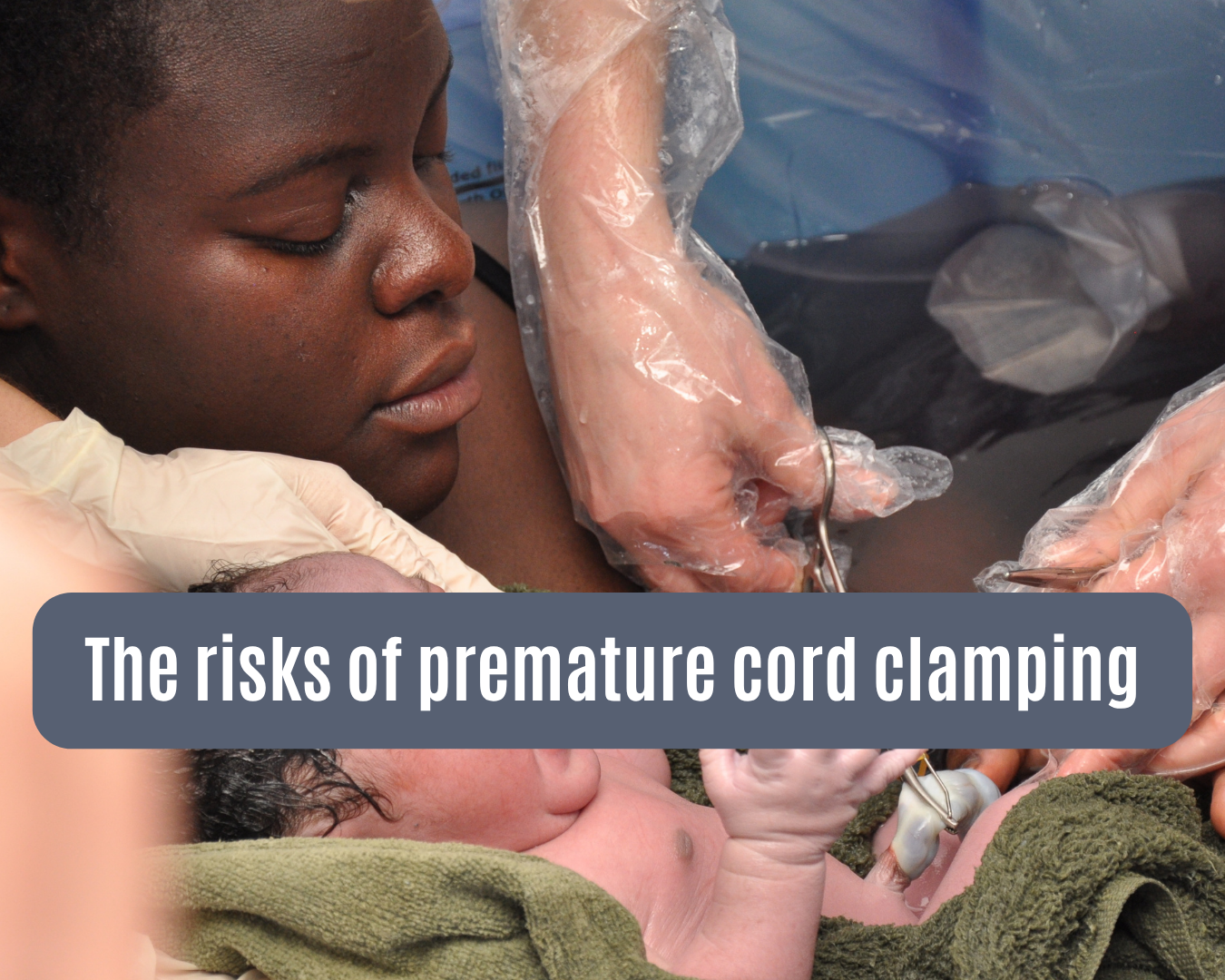
We hear a lot about optimal cord clamping and the benefits associated with it, but I’d like to take a moment to flip the script slightly. When we are talking about any kind of intervention, we should really be looking at the risks of that intervention, rather than trying to justify letting nature do its job. Language is important! So let’s look at this standard-practice intervention for what it really is: premature cord clamping.
Cutting the umbilical cord of a newborn before placental transfusion is complete has become standard practice within medical maternity care, with roughly 40% of babies being subjected to premature cord clamping. When we look at the risks of this practice, that percentage is truly horrifying.
When a baby is born, they are still attached to their placenta, which is attached to the mother and is still pumping blood containing essential oxygen, red blood cells, clotting factors, white blood cells, and up to a million stem cells. This is known as placental transfusion and is a vital part of the birth process. Research shows that up to 40% of a baby’s blood volume is transferred back to them during this process. Before a baby takes their first breath, this is their only source of oxygen. That’s pretty vital!
The practice of immediately clamping and cutting the umbilical cord started in the 1950’s when medics began chemically inducing the birth of the placenta (or the managed third stage), which has been the norm since. This is what we see in all dramatisations of birth too, which feeds into the narrative that it’s an essential, time-sensitive thing that needs to happen despite very little evidence to support it. Since a clinical haemorrhage (blood loss) is defined as an acute loss of more than 10% of circulating volume, leaving 30% to 40% behind means the baby is missing 3 to 4 times what they would classify as a haemorrhage.

We hear a lot about optimal cord clamping and the benefits associated with it, but I’d like to take a moment to flip the script slightly. When we are talking about any kind of intervention, we should really be looking at the risks of that intervention, rather than trying to justify letting nature do its job. Language is important! So let’s look at this standard-practice intervention for what it really is: premature cord clamping.
Cutting the umbilical cord of a newborn before placental transfusion is complete has become standard practice within medical maternity care, with roughly 40% of babies being subjected to premature cord clamping. When we look at the risks of this practice, that percentage is truly horrifying.
When a baby is born, they are still attached to their placenta, which is attached to the mother and is still pumping blood containing essential oxygen, red blood cells, clotting factors, white blood cells, and up to a million stem cells. This is known as placental transfusion and is a vital part of the birth process. Research shows that up to 40% of a baby’s blood volume is transferred back to them during this process. Before a baby takes their first breath, this is their only source of oxygen. That’s pretty vital!
The practice of immediately clamping and cutting the umbilical cord started in the 1950’s when medics began chemically inducing the birth of the placenta (or the managed third stage), which has been the norm since. This is what we see in all dramatisations of birth too, which feeds into the narrative of it being an essential, time-sensitive thing that needs to happen despite there being very little evidence to support that. Since a clinical haemorrhage (blood loss) is defined as an acute loss of more than 10% of circulating volume, leaving 30% to 40% behind means the baby is missing 3 to 4 times what they would classify as a haemorrhage.
So why are medical staff routinely giving babies haemorrhages?
Well, it often comes down to either just being in the habit of doing it regardless of the evidence and recommendations, or it is done in a situation where the baby requires some kind of resuscitation. The former point is something that happens very often with maternity care; it takes a very long time for new protocols and recommendations to be put into practice, and so often the care being provided is not in line with evidence. This is why it is always worth doing your own research and using your own common sense to make decisions rather than solely relying on what you’re being told by your midwife. Ask questions. Scrutinise the evidence.
In terms of resuscitation being used as a reason to cut the cord prematurely, there are conflicting views on this too. It seems that for the most part this is done for practical reasons rather than being based on any medical benefit. Most c-sections are performed in theatres that don’t have a bedside resuscitaire (the table and equipment used to give resuscitation interventions), so the premature cutting of the cord is purely to enable the staff to move the baby over to the table. However, we know that this equipment can be used bedside because some hospitals have this option and portable resuscitation equipment is taken to homebirths, so why is this not being invested in when the evidence so clearly shows that staying attached to the placenta can be life-saving? Surely the babies who are deemed to need resuscitation are the ones most in need of that connection to their oxygen supply?
Another reason cords are sometimes cut prematurely is to take blood gases of a baby who is seemingly struggling to cope to determine their oxygen, carbon dioxide and pH levels immediately after birth. The logic behind this one is a little crazy if you ask me. The premise of cutting a baby off from their oxygen supply to measure their oxygen levels so you can document whether or not that baby was, in fact, struggling and to what extent seems counterintuitive. The reason for doing this analysis comes down to the medical system covering their own backs, rather than for any kind of benefit to the baby.
What does the evidence say?
Rachel Reed wrote about this years ago; I’ve linked her blog post below, and she has referenced some really important research on this topic. If you’d like to delve into the research, I highly recommend reading her blog post and the reference papers.
In short, the evidence shows that prematurely clamping and cutting a baby’s cord can lead to low oxygen levels, low red blood cell count, low Apgar scores and even death. Conversely, it is hard to find any evidence that leaving the cord attached has any related harms. Resuscitation interventions can be performed whilst the cord is intact. Taking cord blood gases, although unnecessary, can be done whilst the cord is intact. Any other checks can absolutely wait, but if the mother does want these, they can also be done whilst the cord is intact.
The reframe
We need to check our language and stop framing “delayed/optimal cord clamping” as an extra that you can request and, if the stars align, have approved. Clamping and cutting the cord is the intervention, not the baseline, so let’s call it that and treat it as such.
If you are planning on giving birth with medical staff around, it’s worth thinking about this intervention and the ways in which you might need to advocate for yourself if you do not want it. If you are planning on birthing without medical staff, then this is one less thing to have to advocate for because you can take your time without any external pressure, provided everyone in your space is following your lead.
If you would like to chat with a doula about this topic or anything else, please don’t hesitate to reach out: hello@greatermanchesterdoulas.com or you can book a session with us here.
Resources:
– The Placenta: essential resuscitation equipment – Rachel Reed
– Care of the Newborn and Cord During the Third Stage of Labour
– Neonatal Outcome Following Cord Clamping After Onset of Spontaneous Respiration
– Intact cord resuscitation versus early cord clamping in the treatment of depressed newborn infants during the first 10 minutes of birth (Nepcord III) – a randomised clinical trial
Leave a Reply